
The Endgame
Newsletter #134 - Do not drop it, or you are lost

Toronto, June 14, 2026
Do not drop it, or you are lost
I still have a book of Greek legends given to me by my mother when I was seven years old (The Enchanted Ship by Jo Manton).
One legend in the book is the story of Theseus and the Minotaur. The Minotaur was a monster who lived in an underground labyrinth on the island of Crete and dined on the flesh of young men and women. Prince Theseus of Athens, urged on by the beautiful Princess Ariadne of Crete, set out to slay the beast. Before Theseus entered the labyrinth, Ariadne gave him a ball of crimson thread to guide him out once he had killed the Minotaur. “Hold this thread and unwind as you go,” she told Theseus. “Do not drop it, or you are lost.”
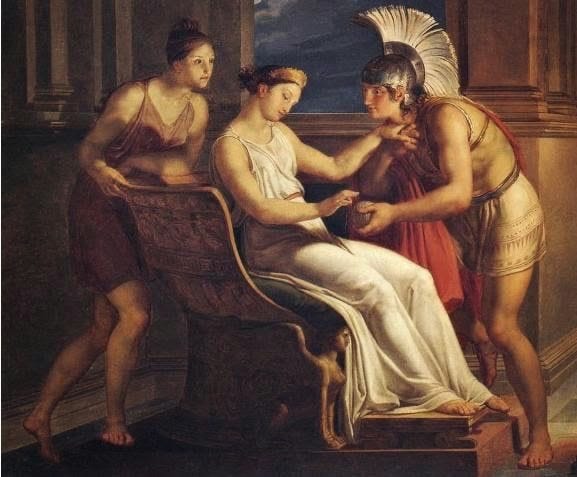
The metaphor of Ariadne’s Thread is found in many places. One is in logical problem-solving. Wikipedia tells us: “The key element to applying Ariadne’s thread to a problem is the creation and maintenance of a record... of the problem’s available and exhausted options at all times. This record is referred to as the “thread”...” Another is its use in understanding literature that presents continuity in the face of change. The poem “Little Gidding,” one of T.S. Eliot’s Four Quartets, is an example: “We shall not cease from exploration/ And the end of all our exploring/ Will be to arrive where we started/ And know the place for the first time.../ And all shall be well and/ All manner of thing shall be well...”
Most of all, the idea of Ariadne’s Thread can apply to an individual life, allowing us to discern a coherent story beneath a cacophony of apparently chaotic events. Look for the thread in a life.
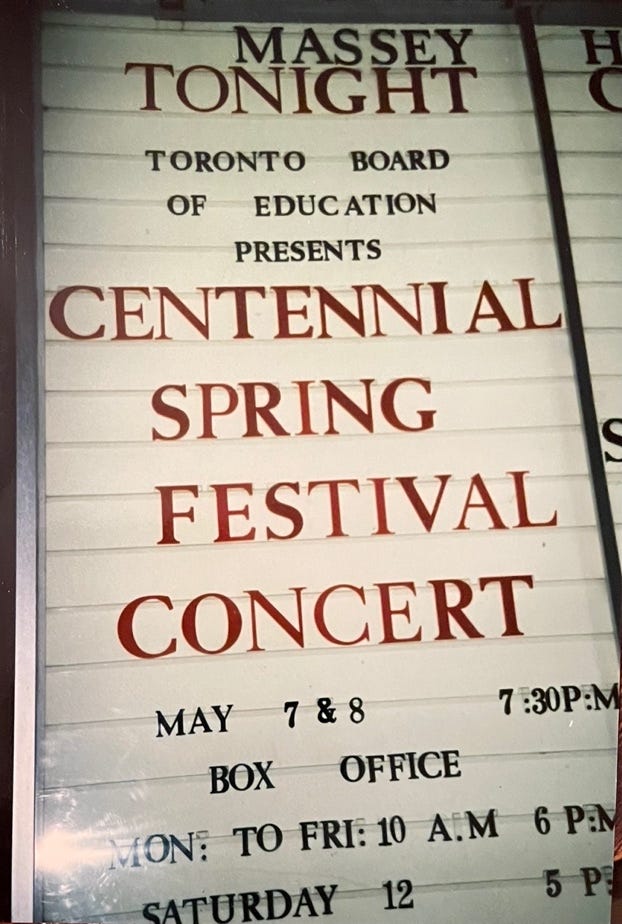
Here is an example of Ariadne’s thread in my own life. In the mid-1980s, when my daughter Gabrielle was about ten, she sang in a student choir at the Toronto Board of Education’s annual May Festival (May 7th and 8th), an event dating back many decades and held at Massey Hall. The program included songs from the May Festival of fifty years before. The idea was to connect contemporary students with the history of school music. I was impressed and amused to see children of immigrant parents from all over the world—many from former British colonies—enthusiastically singing Rule Britannia (“Britons never will be slaves”) and Land of Hope and Glory (“God, who made thee mighty, make thee mightier yet!”) Toronto seemed a confused but wonderful place, and I was a proud father.
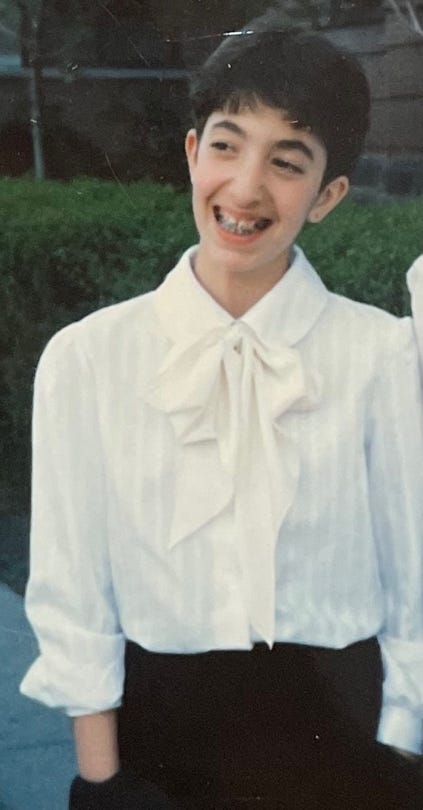
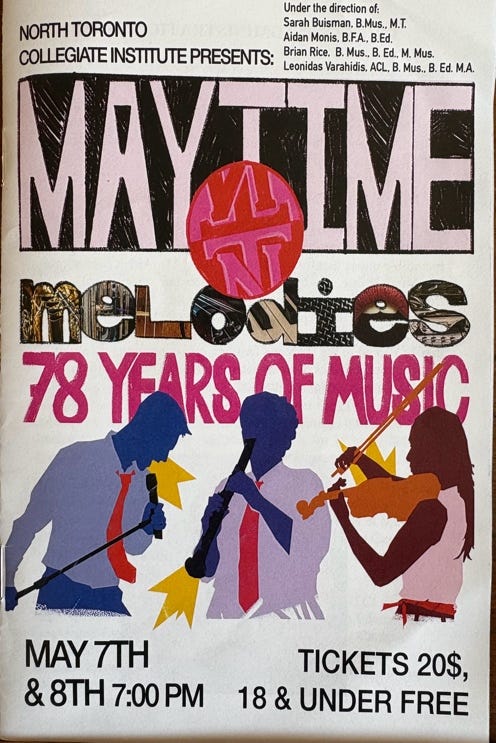
Last month, forty years on or so, I went to the 78th Maytime Melodies at North Toronto Collegiate Institute (by coincidence, also held on May 7th and 8th). Gabrielle’s daughter Rosie, a Grade 9 student at North Toronto, was singing in the school choir at this annual and highly-regarded event. This time traditional patriotic British songs were not on the program. There was nothing at all about ruling the waves or becoming mightier yet. The highlight of the choir’s performance was a song called “The Seed” by Aurora Aksnes, an ethereal Norwegian known simply as Aurora. This song delivered a different message from the songs of four decades before and fifty years before that: “When the last tree has been cut down, the last fish caught, the last river poisoned, only then will we realize we cannot eat money.”
The message may have changed, but, as at Gabrielle’s performance over forty years earlier, and that of her predecessors almost a century ago, students who loved music performed enthusiastically and professionally and used song to tell the old what’s important in their time. That has not changed. The thread had not been dropped. I was a proud grandfather.
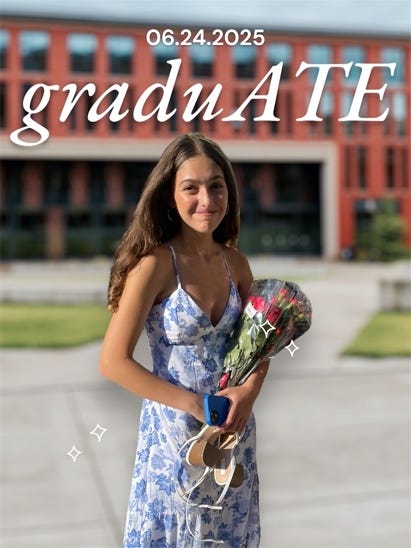
I thank my mother—Gabrielle’s grandmother and Rosie’s great-grandmother—for the book of Greek legends.
*****
A few reader comments on Endgame #133
From Rick Salutin: “i had a shakespeare prof at brandeis in the 60s, who doubled as a mystery writer under a pseudonym, who told us he had no idea why anyone would agree that iago was motiveless. he said iago tells us exactly why he wants to destroy othello: he is jealous. of the military glory, the stature, cassio’s advancement, desdemona. also maybe because he thinks othello has slept with his own wife. if anything his behaviour is overdetermined, a la sartre’s category, not unexplained. i haven’t bothered looking any of this up. i think AI should get a rest on sunday.” And in a supplementary note: “the prof i mentioned... also told us, if you think jealousy isn’t a strong enough motive for murder and other evil, you haven’t spent enough time around an english lit faculty.”
From Alexandra Raphael: “When I first started to practice law, a senior partner told me that, in a client’s eyes, the only thing which distinguishes one lawyer from another is reputation. ...the importance of reputation in the legal profession confirms the stereotype of the pompous lawyer.”
David (a retired film director) writes: “On reputations … Coincidentally, yesterday on YouTube I watched the troubled actor Kevin Spacey speak independently and also be interviewed at the Oxford Union. Next, the algorithm immediately took me to Piers Morgan’s controversial UK interview show where he talked skillfully with Spacey. The brilliant actor’s professional and personal lives changed suddenly and irremediably seven years ago when he was “outed.” And disappeared by hypocritical Hollywood. I am left deeply affected. And eager for the reappearance he is orchestrating by working with many leveraged friends. I miss his work. I am surely not alone.”
From Janet Price: “What a powerful topic, especially as we age. I think we sometimes assume that if we work hard to build the reputation we seek for ourselves it will become our legacy and we can reach the end of our life content, and even proud, of it. But, as you write, that legacy that can take a lifetime to build can be destroyed, or in the least greatly weakened, in what feels like a moment. I had a dear family friend who built a powerful legacy of accomplishment and fame as a religious leader dedicated to caring for others and making the world a more loving place by building community, both near and far. That person’s legacy was not only tarnished very late in his life but erased for the most part by the accusation of sexual impropriety. I had never imagined that to be this person’s endgame, someone I personally respected greatly. And though I will never know the veracity of the claims, I did watch a person’s reputation and legacy that took a lifetime to build, destroyed in what felt like an instant. The take-away? Well, possibly one might be able to move towards one’s endgame with an inner peace about how one has lived their life, protected from the ebbs and flows around us. Maybe?”
The last word goes to Lynn Farrell: “My reputation recedes me.”
*****o
P.S. My friend Sara Street took these extraordinary pictures of owls in her Etobicoke backyard. The owls showed up, stayed for two days, and then left for who-knows-where. Merlin BirdID says that they are Eastern Screech-Owls.

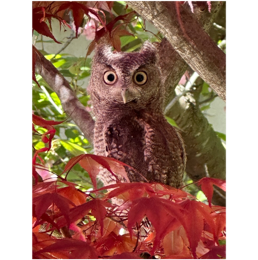
Grand-parenthood is the reward for a parenting well done. Congratulations, Philip! It is also the thread that brings you home.
I keep thinking about you and Parkinson's. As you might know, I was misdiagnosed and lived with the condition for ten months. The mind/body connection is so strong and I had many good reasons for believing the diagnosis (chemicals in my careers as a graphic designer in the cut and paste days and as an oil painter; plus, my Dad had it). I became hyper-vigilant and every new twitch or ache and pain was attributed to PD.
I was also in a car accident shortly after the diagnosis, totalling my car and resulting in a concussion or two. Luckily I had found someone online who worked with people with PD, a combo of brain work and exercise based on Pi. Quite brilliant. Concussion is a brain injury but no one treats it; the focus is on the body so working with this person was very helpful.
The symptoms were caused by a medication I had been taking for over 20 years and not by Parkinson's. I had outed myself on Facebook so friends would know why I had tremors and was using a cane. I am off the medication now and the symptoms have disappeared. Of course, at 76, there are other bodily issues now betraying me...
PD is nasty but, as my friend rightly told me, it's a diagnosis and not the definition of who you are. Stay well and keep writing. I look forward to reading your thoughts.
And those owl photos!