

Toronto, October 11, 2026
The rules of engagement
In E.M. Forster’s Howard’s End Margaret Schlegel famously muses “Only connect...”
Margaret’s full admonishment to Henry Wilcox is more complicated: “Only connect the prose and the passion, and both will be exalted, and human love will be seen at its height. Live in fragments no longer. Only connect and the beast and the monk, robbed of the isolation that is life to either, will die.”
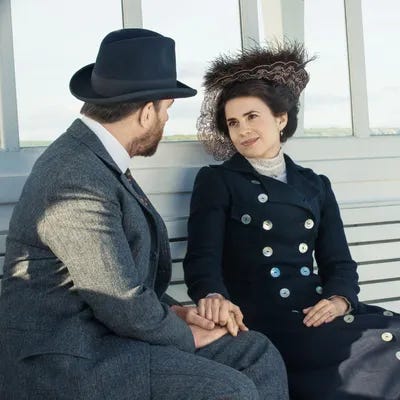
Old people are often exhorted to “only connect.” We are told that connection is essential to aging well. Academic studies predictably support this proposition, e.g., the ominously titled, “Loneliness in Older Persons: A Predictor of Functional Decline and Death,” or a paper called “The effect of social relationships on cognitive decline in older adults” which tells us (surprise!) that poor social relationships are associated with cognitive decline.
Connection includes friendship, of course, but goes far beyond that. In The Human Condition, Hanna Arendt argues for “plurality,” by which she means the sharing of the human condition. Plurality does not imply warm social relationships. It means being heard, and acting, even in the context of bitter controversy, strife, and disappointment. It means full engagement with life and its sorrows. “Old age hath yet his honour and his toil.../ Some work of noble note, may yet be done... (Alfred, Lord Tennyson, “Ulysses”)
Why would an old person pursue Arendt’s plurality? Why would they attempt to engage fully with a complex and hostile world? Why would they choose to contemplate events and issues that they can’t influence and that disturb their peace? As every contemporary film goer knows, Odysseus was unusual, perhaps unique, in his energy and fortitude.
There are reasons for the elderly not to engage. The biggest is the limited amount of time available to the old. Time once seemed abundant, but now it is in short supply. Chat GPT says that my life expectancy is eight years (“That is the average for men your age... not a prediction of your lifespan.”) On my health expectancy the bot is mealy-mouthed: “Remaining largely independent into your late eighties is a plausible possibility, rather than a reliable forecast.” In other words—and I don’t need a bot to tell me this—there’s not a lot of time left. What I have should be spent carefully, not frittered away.
Once it was reassuring to have a jam-packed calendar. There were people to see, places to go, things to do. There were meetings to attend, tasks waiting, books to write, speeches to give, phone messages to return, flights to catch, lingering lunches... People solicited your opinion. You seldom said no to an invitation. You were engaged with the world. You had a place. You didn’t make careful judgments about who to see, where to go, what to do. Time was a seemingly endless commodity. You did everything, wanted more, and loved it all.

But when you are old it’s different. Sure, there are still people to see, places to go, things to do, but far fewer than before. There is less opportunity—people have died, invitations have dried up, you wear the slowly enveloping cloak of invisibility. The elderly have more wisdom, and less desire, about who to see and what to do. And always the cruel hand of time hovers... “Like as the waves make towards the pebbled shore,/ So do our minutes hasten to their end.” (Shakespeare, Sonnet 60)
Plurality may recede, but friendship remains. Who could live without friendship? Not to confide to a sympathetic ear, walk in the park with an amiable companion, laugh with a friend—that would be a chilling circumstance. Isolation is life only to the beast and the monk.
*****
Some reader comments on Endgame Essay #140 (“One hundred years from now, All new people”)
John writes from Scotland: “I did enjoy Cixin Liu’s novels... The virtuous position is the obvious one, but I doubt most are inclined towards personal sacrifice for future lives as yet unlived. Adam Smith may have agreed with me here. Lots to ponder as I consider my next career.”
From my nephew Vic, in Grantham U.K., birthplace of Margaret Thatcher and Isaac Newton: “My wife uses no biological washing powder, free from this and that, organic food, reusable bags and paper packaging. All for the next generation, but what about me, I want my clothing to smell nice, I like the convenience of mass produced food! But you get older and think, what has my generation left for our children and grandchildren? What did our grandparents and parents leave for me? Parents and grandparents, 1940’s nuclear weapons, the ability to destroy the world at a push of a button. 2000’s, our generation, developing AI who thinks the worst thing that has happened to the planet is human kind. It pushes the button for us. We do not create or produce anything for the future. As a detectorist I found a coin from 30BC in almost mint condition as they took pride in its production. I have found a modern coin from the 1980’s which had almost completely decomposed because we have become a throw away civilization. So as I do my bit to reduce plastic and greenhouse gases, I fight a losing battle. What can I leave my children and grandchildren, hope or hopelessness, I make no difference.”
Gabriel Peachey writes: “To renege on the future of humanity is to follow the path of Alistair Crowley whose motto was “Do as thy wilt” regardless of anything or anyone. What of your children and grandchildren, are we not responsible to continue the species without wilfully destroying the planet?”
*****
Some words I like
(with thanks to AI for the quotations)
Picaresque – “Picaresque is an adjective and noun formed in English by derivation and modeled on a Spanish lexical item (pícaro + -esque), meaning pertinent to or characteristic of rogues, and originating in Spanish literary fiction.”
Ankle-flashing – “In political commentary, ankle-flashing is a metaphorical idiom used to describe a politician who is teasing an idea, flirting with a specific faction of voters, or subtly signalling a policy shift without making a full commitment. Borrowing from the historical Victorian taboo where showing a sliver of ankle was a provocative, deliberate hint of what lay beneath, political analysts use the phrase to describe calculated political signaling.” I was introduced to this word in a podcast discussing the new U.K. prime minister, Andy Burnham.
Not-rich-enough – Recently I heard this phrase used to describe a newly-invented political/economic class, as in “working class, middle class, upper class, the not-rich-enough class, the rich...” Those who cannot afford to charter a plane, and are condemned to fly commercial, are not-rich-enough.
Collywobbles – “A feeling of nervousness, fear, or uneasiness in the stomach, or historically, an upset stomach and intestinal cramps.” When I was a child, my mother would sometimes ask me if I had the collywobbles. I’m guessing the not-rich-enough often suffer from collywobbles.
Lingering luncheons! First such a lingering lunch presents a slew of what you can’t eat.Too much salt,no shell fish and then the furisimide signal of oh my God I have to piss now….too late! And who will pay? Do you dare reveal the conversation stopper of your lower regions?
But .yes I would love to have a lingering lunch with you but let us avoid Trump
Yes 'there is not much time left'. One becomes aware of such things and of change and changes to come. I joined substack as one of the motivations is to express what one knows whilst one can before the sudden all gone. One finds onself posting warnings for those who remain with an urgancy arising from the awareness of how little time there is left. Seems that in these times all my poetry is warnings. As to the past ... well it's always the eternal now but it's not shadows around us, it's other souls passing through, if one loves them the urge to leave something useful behind is very strong.