

Toronto, September 13, 2026
Almost a doctor
I had dinner recently with an acquaintance who had just retired from a long and successful career as a lawyer.
“What are you going to do now?” I asked, and casually mentioned some of the occupations taken up by older people I know who have time on their hands. “Travel? Golf? Substack newsletter?”
“None of that time-wasting rubbish,” he said. “I’ve applied to medical school. I want to be a doctor.”
“Bill,” I said, “no offence, but you’re in your sixties. You’re way too old for that. Anyhow, what medical school would admit you?”
He looked smug. “Obviously you’ve never heard of Dawn Zuidgeest-Craft,” he said with satisfaction. “She graduated as a doctor at 74 and is now a resident in a Michigan hospital. Or what about Toh Hong Keng who got an M.D. at 70. It’s never too late. Lots of medical schools—in the Caribbean, the Philippines, places like that—take old people. I’ve applied to a school in St. Vincent and the Grenadines. Nice part of the world.”

I was impressed. Bill had rejected the accepted wisdom. He had turned his back on the conventional idea that vocation is over when old age arrives, that the elderly are necessarily restricted to trivial avocations, that any attempt by an old person to pursue a new and daunting career is absurd. Make-work must fill your dwindling days, so goes the orthodoxy. Shut up and go potter in the garden.
If only I could become a doctor myself! It would be a dream come true, partial redemption of a wasted career life. But I am 82. Google’s Gemini, which knows everything, says “many medical schools do not have a formal upper age limit, but getting admitted at 82 is extraordinarily unlikely due to practical, physical, and institutional hurdles.” It goes on to list these hurdles with depressing precision (e.g., “Medical school and subsequent residencies require gruelling 60- to 80-hour work weeks, high-stress environments, and long standing hours that strain physical stamina.”)
Cynnie and I have been watching the TV series “ER.” There are 331 episodes spread over 15 seasons (1994-2009). So far we’ve watched 158 episodes and have just started the heart-rending eighth season (fans of the show will know why I call it heart-rending). ER is one of the great TV series, better than “The Pitt,” a contemporary imitation of ER, better even than acclaimed series like “The Sopranos” or “Breaking Bad.” It immerses you in the complex and dramatic world of a hospital emergency room over more than a decade, and (the experts tell us) gets most of it right, particularly when it comes to medical terminology and the broad logic of emergency medicine.
In each ER episode, after the opening credits, a patient is whisked from an ambulance in the ambulance bay and comes crashing through the ER doors on a gurney with doctors and nurses pushing the gurney and running alongside and yelling. I am overcome with excitement and start yelling myself, from the sofa in the TV room. “He’s crashing!” I shout at the TV. “Two units of O-negative! He’s bradycardic. Bag him! Intubate! Central line! Push the epi. He’s in V-fib.” I make further helpful suggestions when it comes to the emergency surgery that generally ensues.

I tell Cynnie that after having watched 158 episodes of ER (not to mention researching and tending to my own ailments), I’m almost a doctor. She points out that “almost” is as close as I’m going to get.
I bumped into Bill on the street the other day and asked him when he was starting his medical studies. “I was accepted to medical school in St. Vincent,” he said. “But I’m not going. My wife pointed out that it’s hot and humid there most of the time. I’m too old for that.”
*****
Some reader comments on Newsletter #138 (“Loose things”)
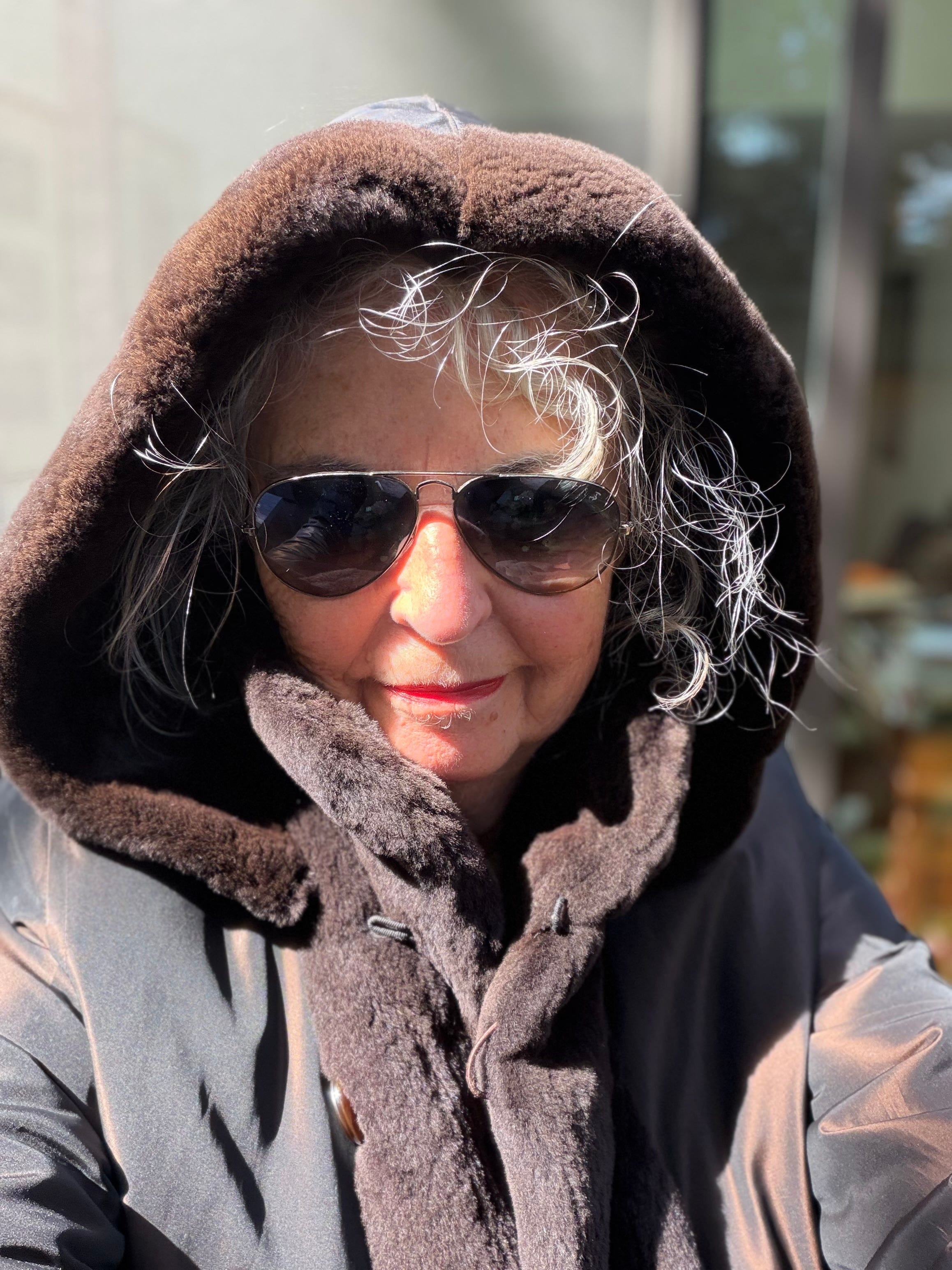
Marion Botsford Fraser writes from Vancouver and sends a picture: “My Ellen’s coat is a fully reversible, full-length, hooded raincoat. One side is waterproofed bronze taffeta. The other is…fur. Beaver, sheared beaver to be precise. When I tried on this garment, in Ellen’s basement, I knew instantly that it was fur; I grew up in northern Ontario in the 50’s where every woman had a fur coat. (Not a luxury, a necessity; even children’s snow boots had fur lining.) My mother had a massive, full-length beaver coat with shoulder pads. It later became a fur jacket, and then a shorter fur jacket, worn forty years later by my grandmother in northern Michigan. But was Ellen’s beautiful coat really fur? I took it home, snipped off a tiny tuft and held it to a lit match. It singed, and smelled like burnt hair. There are no labels anywhere on this coat. Naturally I took it into Holt’s fur salon in Toronto for expert assessment; oh yes, they said, this is one of ours. There are very few days in Vancouver when the weather is exactly right for a fur-lined raincoat. When I do wear it, I tell myself: this fur is so good, it looks fake. No one has ever thrown eggs on my Ellen’s coat.”
From Nancy Hughes Anthony: “I was so moved by your piece today because you have Murray’s jacket! Brian and I were with Murray and Martha in Nantucket when he bought it at Murray’s Toggery, a shop on the Main Street. Murray hemmed and hawed (as he did) but bought it. Martha tells me he never wore it. I am thrilled you are wearing it.”

Lakshmi writes: “My father passed last year. I brought home some of his old shirts as well as a few pairs of shorts he wore in the last two months of his life. The shorts fit me well, and although his shirts are a tad long AND the cut is decidedly a guy’s... I wear them regularly. There is a certain poignancy to the experience because I recall clearly buying the shorts and the shirts; I remember the visuals of him dressed in those clothes; it’s all very vivid and precious at the moment.”
From Susan Boyd: “I too have precious objects previously owned by loved ones who have died: jewelry, a pair of linen trousers, china from my mother…. I chuckle when I decide to wear the linen trousers because they are not really ‘me.’ Yet my friend insisted they were, possibly because they were not really ‘her’ either!”
Ian Scott: “The combination of the lingering impact of a friend’s coat, along with the Leonard Cohen quote, was evocative of another one of Cohen’s songs, ‘Famous Blue Raincoat’ that was, as he sang, torn at the shoulder. As you wrote, sometimes a piece of clothing can have a greater meaning that mere cloth and be, as Cohen wrote, ‘a shining artefact of the past.’”
From David Wolinsky: “My storage locker in my building is jammed to the hilt with things I felt I couldn’t give away, throw away or sell when I cleaned out my folks’ condo 46 years ago when the last of them passed, and which have travelled with me on the five occasions when I moved since then. They are now my children’s problem once I move on, along with whatever worthless crap of mine they feel constrained to keep for their children to deal with.”
Arlene Perly Rae comments: “There is an old—Egyptian, I believe—saying that we die twice. Once when we stop breathing and the second time when our name is spoken for the last time.”
And the last word goes to Sandy Horodezky: “Your article reminds me of a wooden sign on a ‘talking tree’ in a 700 year old forest monastery in Chiang Mai, Thailand at the foot of Doi Suthep. The monks hang wooden signs with short proverbs (in Thai and English) from the trees along the footpaths: ‘Cut yourself some slack. Remember, 100 years from now, all new people.’”
*****
A great man has died
The New York Times reports the death of anarcho-confectioner Noël Godin: “Noël Godin, a Belgian entertainer and anarchist who demonstrated his distaste for pomposity by hurling cream pies at executives, politicians and celebrities, a dessert-based form of protest that splattered Bill Gates, Nicolas Sarkozy and Jean-Luc Godard, among many others, died on Aug. 23. He was 80.” One of Godin’s favourite targets was the preposterous egomaniac Bernard-Henri Lévy.
*****
As someone who stopped being a doctor at age 69 after a long career in medicine that I loved, it is jarring to read of people entering the profession at an older age than when I left. It’s not just that medical education is demanding but also that it is a huge investment by society that pays returns over three to four decades for clinical care, research, and teaching the next generations. That’s time these septuagenarians don’t have, unless they want to end up like this fake news item on The Onion celebrating world’s oldest neurosurgeon turning 100: https://youtu.be/mSt1m4NFUl8?si=9OHrjfsj_VBzm69k. This reminds me of the possibly apocryphal story of Margaret Atwood encountering an admiring neurosurgeon at a party who tells her that when he retires, he really wants to write a novel; she counters that when she retires, she really wants to do neurosurgery. Stick to watching ER and The Pitt. They may have technical advisors who ensure the accuracy of the terminology and the procedures, but the pace and intensity of the drama are about as accurate as police or law procedurals. The former chair of CAMH, a retired OPP Superintendant, told me that in the cop shows I liked, what happened in a single episode would, spread over a lifetime, make for an exciting career. The only show he felt captured the reality of police work? Barney Miller. All that said, I get the allure of a life in medicine; it was wonderful.
What horse shiit! You posed as an erudite philosopher,only to be revealed as a devotee of ER.I suppose it is better than The young and the restless