
The Endgame
Newsletter #124 - Emotion recollected in tranquility

Toronto, December 28, 2025
Emotion recollected in tranquility
“And now, with gleams of half-extinguished thought,/ With many recognitions dim and faint,/ And somewhat of a sad perplexity,/ The picture of the mind revives again...” (William Wordsworth, “Tintern Abbey”) Later Wordsworth wrote: “Poetry is the spontaneous overflow of powerful feelings: it takes its origin from emotion recollected in tranquillity.”(Preface to Lyrical Ballads)
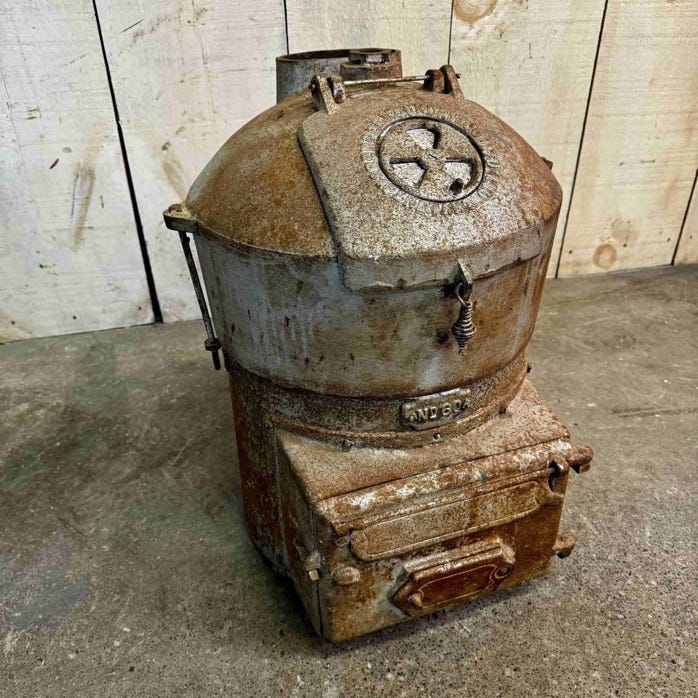
When I was very young, in the late 1940s, my family lived in a modest semi-detached house in north London. Hot water came from a coal fired boiler in the cellar which had to be stoked frequently. I recollect little about that house in north London, but I remember clearly the sound of my mother stoking the cellar boiler in the early morning so that my father would have hot water to shave. I hear that sound even now, although it is dim and faint, as I lie tranquil in bed in the early morning, more than 70 years later, an ocean away, with my mother dead for more than a decade. The sound is the sound of security and of my mother’s love, and its recollection comforts me.
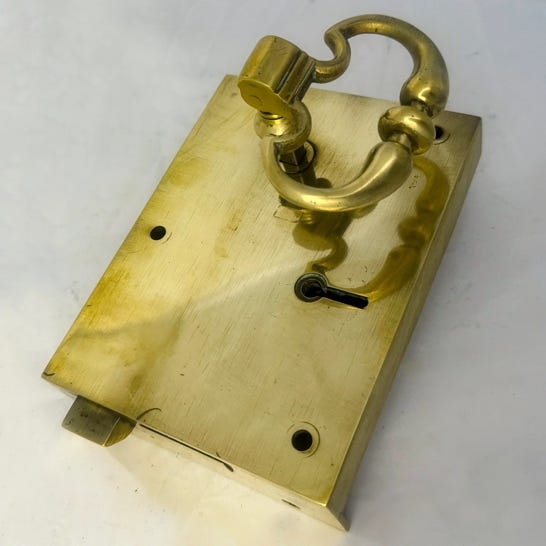
Years afterwards, I spent many happy times at the Buckinghamshire country house, long since demolished, of my affectionate and generous aunt and uncle. I remember the shape, feel, and sound of the brass doorhandle in the bedroom where I slept. As I dream in a half-sleep today, or traverse the past in my mind as I idly walk down a winter street, I recall the feel of that handle, the twist I gave it to open the door, the satisfying click of the bolt as the door latched when I shut it. This particular memory triggers other recollections of treasured times in the Buckinghamshire house, as the taste of a madeleine opened the door to memories for the narrator in Marcel Proust’s novel À la recherche de temps perdu.
When I was a university student in Winnipeg, one year I had a summer job that I hated. I would wake in the morning dreading the prospect of another day spent in an awful place. Before I took the bus to work, to collect my thoughts and calm down, I would go to the backyard of our house for a brief while and sit on the box by the laundry line where my mother hung the clothes to dry. It was cool in the early morning, and there was birdsong, and it was peaceful. After a while I felt able to deal with the day to come. The memory of that precious morning interlude in the backyard—the cool air, the birds, the peace—stays with me, and I often summon it when I need help dealing with awfulness.
The house in Winnipeg (also now demolished) was built in the 1920s by Paul Hiebert, a chemistry professor at the University of Manitoba and author of the largely-forgotten literary satire Sarah Binks: The Sweet Songstress of Saskatchewan (“Oh calf, that gambolled by my door,/ Who made me rich who now am poor,/ That licked my hand with milk bespread,/ Oh calf, calf! Art dead, art dead?”). When Hiebert retired from the university he moved to Carman, a small town south of Winnipeg. In 1965 I wrote to him, said I was an admirer of Sarah Binks, and asked if I might visit: He quickly sent back a letter of welcome. I went to Carman with my charismatic friend Hal Kroeker, who was always up for an adventure. We had a fine afternoon with Hiebert. Hal Kroeker died in 1984, only 41 years old.
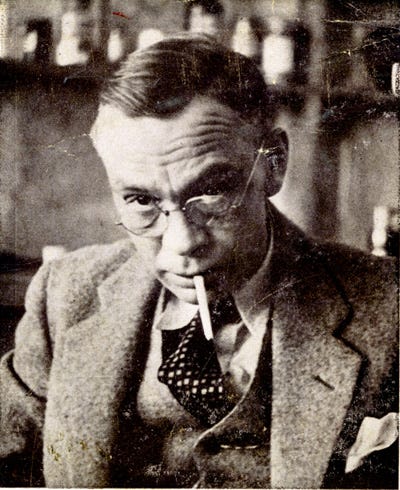
Sound, touch, a quiet time in the cool morning air, visiting Paul Heibert in Carman with my friend Hal. “That time is past,/ And all its aching joys are now no more,/ And all its dizzy raptures.” (“Tintern Abbey”)
*****
Some reader comments on Endgame #123 (“We The North”)
Randy Hahn writes: “I have been a fan of watching basketball for many years. When I do have the opportunity to go to a live NBA game, I find it is an opportunity to appreciate the intensity, speed, athleticism, and skill that television does not capture as well. But I do not share your enthusiasm for what is happening off the court... Rodney Dangerfield once observed that ‘I went to a fight the other night and a hockey game broke out.’ Following which one might say ‘I went to the carnival and a basketball game broke out.’”
From David Wolinsky: “I share your love of basketball for a more selfish reason. Unlike football, baseball, soccer, golf, hamburgers, French fries, Diet Coke, and cake, basketball was invented by a Canadian, James Naismith, so even though I was vertically, weight, and athletic ability challenged so I could never play the game, as a proud Canadian I always vicariously considered it my game. We The North indeed.”
John Gregory is not in a good mood: “When I attended a Raptors game a few years ago, my reaction to all the spectator involvement, t-shirt specials, noises here and there and flashing lights, was to think that the organizers didn’t have much confidence in the game itself to hold our interest. And frankly, when one or both teams will likely be scoring 100 points a game, how can one attach much importance to any basket, however elegantly netted? So the game was for me a once-in-a-lifetime experience.”
Bob Collison: “Perhaps this is the high school Touchdown Quiz three-time laureate in me but I was always under the impression that Isaac Newton, who died in 1727, or was it John Locke, who met his maker in 1704, were the last humans ‘to know everything.’ But both ‘circa’ the same time as Liebniz, so guess the last time one could be a true ‘know it all’ was in the early 18th century. But my odds are on Newton or Locke, but maybe that’s just the anglophile in me. But totally agree about basketball. Like you, Philip, came to appreciate its athletic artistry very late in life.”
From Gerry Posner: “I loved your piece on basketball Philip. But you would have to pay me to go watch basketball. This comment comes from someone who has followed sports closely all my life. Not just followed but played several sports. I have had 45 years of Racquetball, 10 years of Pickleball, some tennis, and years of playing baseball, and football. I was for years a regular at Blue Bomber games as well as at the Winnipeg Jets. Even to this day, I remain involved in following sports. With all of that, I say to you that basketball is a sport which does not attract me in the least. It is one sport that rewards height. My family lacks height and indeed hair. I cannot identify with a sport that makes it impossible for a short guy to play. While it is true to say height helps, there is still room for smaller competitors to play at a high level. Not basketball. Volleyball has the same problem for me. I might add that I played basketball as a kid but then, the height disparity was not so great. So no hoopla for me about basketball. As in none.”
“Neural Foundry” comments: “The insight Charlie shared about ‘We The North’ being more about the new, multicultural Canada than just geography is spot-on. What I find really interesting is how sports become entry points into communities we might otherwise never join. I had a similar moment at a cricket match years back, totally out of my element but suddenly part of something bigger. The accessibility angle (cheap, play anywhere) versus hockey’s barriers is such a subtle but powerful detail about who gets to belong.”
The final word goes to Naomi Duguid: “Loved this. The way you leapt joyfully. I’ve never been to a Raptors game... Now I’m tempted.”
*****
Note to readers: I’m heading to Costa Rica in a few days on a family trip. We went there this past January and had a wonderful time (see Newsletter #94 - “Three generations and a bunch of birds”), so we’re going back. There won’t be a fresh Newsletter until January 24. Happy New Year!
******
Meanwhile, I haven’t stopped flogging the book, although—calm down—I’m going to stop soon.
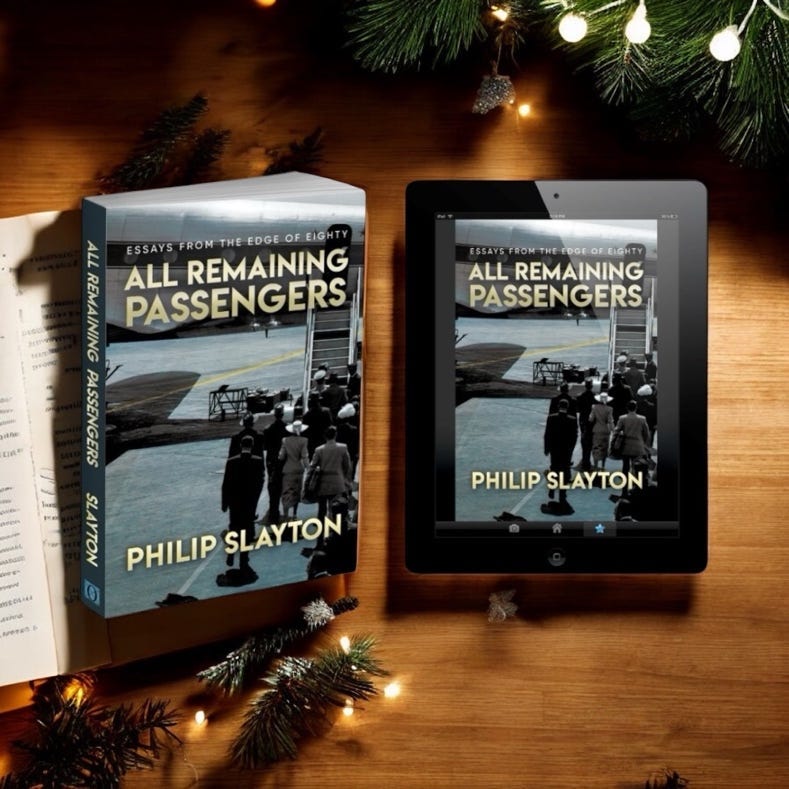
All Remaining Passengers is available from Amazon and other online book sellers in most countries, and from some independent bookstores in Canada (coast-to-coast) including Ben McNally Books and Book City (Yonge & St. Clair branch) in Toronto, Munro’s Books in Victoria, B.C. (where, for some reason, it’s selling like warm cakes), Russell Books in Victoria, and Salt-Water Ballad Books in Port Medway, Nova Scotia.
I love the way your memories are of specific sensations. Mine tend mostly to be visual and olfactory. For example It takes effort to retrieve the feeling of the shoe brush in my hand as I sat on the floor helping my father polish several pairs of shoes, but the smell of the polish is intensely present as soon as the situation comes to mind
Beautiful reminiscences, Philip. Took me back in time to my origins in Montreal, and to similarly detailed recollections of my first home, well, the first home after the womb. I think of the line from Blueberry Hill: "You're part of me still." Thank you.