
The Endgame
Newsletter #126 - Facile?

Toronto, February 8, 2026
Facile?
In my March 2023 Endgame (#16), I wrote about piano lessons with Ruben, my beloved music teacher (I gave him the alias “Luis”): “For fifteen years I’ve toiled away at the piano with the help of Luis. The results are unimpressive, despite his best efforts. I’ll play something I’ve been working on for a while and ask Luis, ‘How was that?’ ‘Not terrible,’ he’ll say gently.”
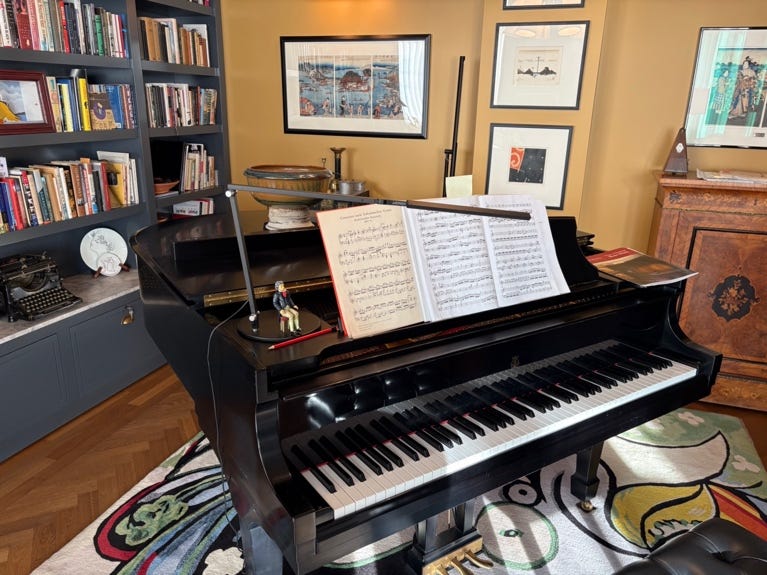
Three years later, after sinking further into music mediocrity and struggling with arthritis in my hands (the music I play should be marked “con mani artritiche”), I haven’t given up the piano. Quite the contrary. I recently vowed that on my 82nd birthday, this July 19th, I will play, from memory, Mozart’s Piano Sonata No. 16 in C major K545.
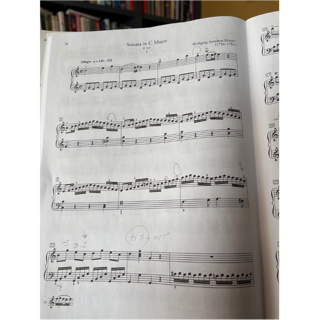
Sonata No.16 has three movements and typically takes about 11 minutes to perform. Mozart said he wrote it for beginners. It’s commonly called “Sonata Facile.” Facile for the likes of, say, Lang Lang, but not for the likes of me. (“It’s not easy at all,” says Ruben: I suspect he thinks my ambition is quixotic.) Here is Lang Lang playing the Sonata’s famous first movement:
Sonata Facile is formally marked as being in C major, my favourite key, the one with no flats or sharps, just white notes. C major is sometimes described as “child-like.” When I came across Sonata No. 16, I said to Ruben, oh good, look, it’s in C major, let’s give it a try, should be easy enough, it’s called “facile.”
But the naming of keys is like the naming of cats, which “is a difficult matter/ It isn’t just one of your holiday games...” (T.S. Eliot) To describe No. 16 as “in C major” is bait-and-switch. Within a few bars, the Sonata starts modulating, moving often to G major (the entire second movement is marked as being in this key), with stops along the way at F major, D major, G minor, D minor, E minor, B flat major, and A minor. And, as if that’s not enough, the sonata is jammed full of scales, arpeggios, chord progressions, etc.
Alan Rusbridger has been the editor-in-chief of The Guardian newspaper and head of an Oxford college. He took up the piano in his fifties. Rusbridger is a man of great talent, ambition, and energy, with ego and hubris to match. At the age of 57, he gave himself a year to learn Frédéric Chopin’s Ballade No. 1 in G minor, Op. 23, one of the most difficult pieces in the repertoire (and about the same length as the incomparably easier Sonata Facile).
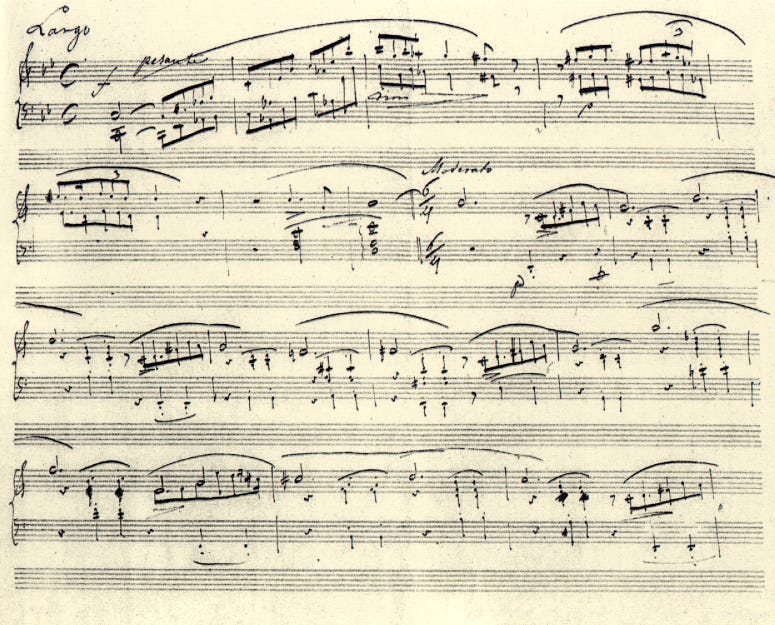
It took Rusbridger sixteen months to learn the Ballade (he was busy editing The Guardian at the time). He then played it at a gathering of his friends who applauded wildly. Afterwards, like any good journalist, name-dropper, and exhibitionist, he wrote a book about the experience, Play It Again: An Amateur Against the Impossible. Here’s Rusbridger talking about himself:
Rusbridger says he wanted to prove something. He says he wanted to prove that at age 57 he still had the ability to learn a very difficult piece of music.
Everyone, I guess, has something to prove, but it can come at a cost. When I sit at the piano to practice Sonata Facile, I am anxious and sometimes my legs tremble. I ask myself, why am I doing this? Meanwhile, the Sonata has seized my imagination. I toss and turn in bed, dreaming of the score, obsessed by its arpeggios, musing over its modulations, trying to work out the harmony...
I mentioned the Chopin Ballade to Ruben, and he promptly sat at the piano and played it effortlessly. It is very beautiful, and I was moved. “You only have to let the soft animal of your body/love what it loves.” (Mary Oliver, “Wild Geese.) If only that were possible.
*****
A couple of comments on Endgame #125 (“The old-fashioned way”)
A charming note from David Wolinsky: “Being somewhat eidetic, aged, and probably a little disturbed, I’m confident this morning’s wonderful Endgame stirred a melange of thoughts in my head unrelated to those in the minds of any of your readers, such as: of your beloved Cynnie, my dear childhood friend Cynthia whom I am unable to recall other than her smiling, laughing, or cheering everybody up; of your Air Canada flight, my Air Canada flight to New York 47 years ago when we hit an air pocket, dropped 1000 feet, after which the pilot calmly announced as packages and people flew through the air ‘We may be encountering some turbulence so we’d ask that you buckle your seat belts;’ of your cane vanity, some 3 years ago after I tripped and broke my shoulder which affected my balance, I was too vain to use a cane so I purchased a shillelagh which I continue to carry and when questioned attribute it to my Irish heritage (in grade 10 a substitute English teacher in criticizing an essay I had written confused my signature D. Wolinsky and called me Mr. O’Wolinsky), and finally, the last picture of Rosie which brought to mind my favourite movie, The Ballad of Cable Hogue from more than 55 ago in which a performing troupe sings ‘Rosie.’ In the words of Bob Hope which I’m sure we both recall, thanks for the memories.”
My dear friend of more than 50 years, Virginia Brown, asks: “Why do you make life so difficult for yourself?”
And finally, Julian Barnes (not commenting on The Endgame) writes this in his new novel, Departures: “I am now in my mid-seventies, and like most older people am sometimes bored by myself—by which I mean my repetitious remembering of thoughts and deeds and, especially, opinions. (And those who never bore themselves, who continue to be publicly entertained by their own lives and their repeated anecdotes, are usually the worst bores on the planet.)”
Loved this... because of course it sent me to listen to different recordings of the sonata. I can't imagine my fingers being dextrous and light!
I cannot possibly provide any sort of intelligent comment except to say that my body is certainly moved by this newsletter. Thank you for taking me out of my usual worries and offering rich pieces of yourself through your writing.