
The Endgame
An encore presentation - The night

(Note: I’m away, and so this Sunday I am reposting one of my favourite old Endgames, #86, first published in November, 2024.)
The night
I’ve been thinking about the night, the time when we sleep and dream, when we seek obliviousness but frequently fail to find it, the time we often think of as something that merely punctuates days but in fact is as important as the day itself. The night has its own richness and poetry.
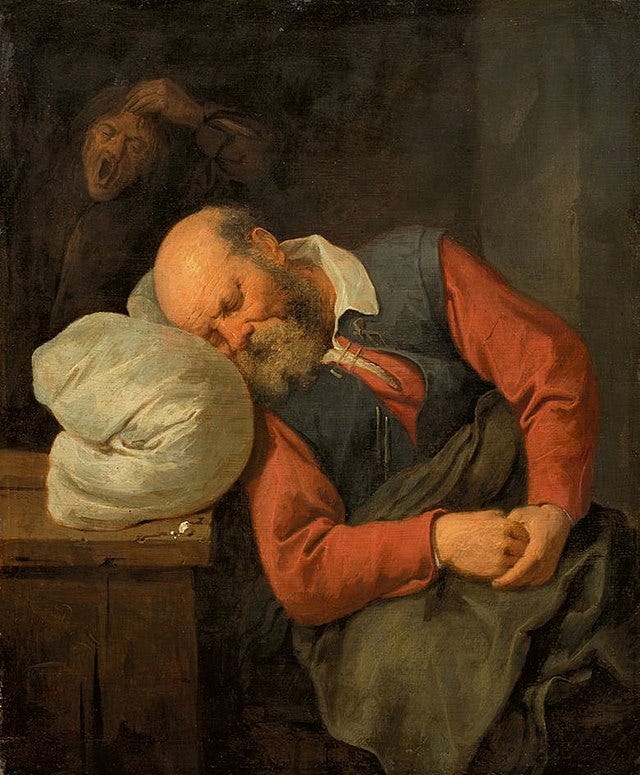
We’re tired. The idea of slipping between the sheets and drifting off to sleep is delicious. Shakespeare: “Sleep that knits up the ravelled sleeve of care, /The death of each day’s life, sore labor’s bath, /Balm of hurt minds, great nature’s second course, /Chief nourisher in life’s feast.” (Macbeth, Act 2, Scene 2)
But we are trepidatious as well. We approach bed with apprehension, particularly as we age. We have not been sleeping well lately—in fact, come to think of it, we have not been sleeping well for quite some time. We thrash around. We wake up a lot. We drift in and out of sleep. We have fantastical dreams. As the night moves along, we hear the clock striking in the other room—two o’clock, three, four... Gerard Manley Hopkins: “I wake and feel the fell of dark, not day./ What hours, O what black hours we have spent/ This night!”
Garbage trucks rumble down the street. The bed is a battlefield. We toss and turn. When dawn breaks we are thankful. This night’s struggle is over. As we age, the struggle gets worse.
But tonight, we are sleeping in a house by the sea. The only sounds are the sound of the waves breaking on the beach, the loon crying in the darkness, the coyote howling in the distance across the bay. Perhaps, in this peace, we will sleep the sleep of the innocent and untroubled. But no, it is not like that, even here. “The fall of rivers, winds and seas, Smooth fields, white sheets of water, and pure sky; I have thought of all by turns, and yet do lie Sleepless!” (William Wordsworth, To Sleep)
In this age of little romance, the poetry of the night is replaced by electronic monitoring. If you are kitted out with a sleep tracker, in the morning you can review the statistics of the night that has just passed. My smartwatch tells me that last night my time asleep was 5 hours and 5 minutes. It tells me all sorts of other things, including the percentage of my sleep that was REM, Core, and Deep (look it up), and my heart, respiratory rates and blood oxygen level while I was sleeping. Occasionally in the morning my watch sends me a congratulatory message telling me that I’ve “met my sleep goals.” I am pathetically pleased by this message. Something has been achieved.
But how do you attach numbers with meaning to the “soft embalmer of the still midnight” (John Keats, To Sleep)?
In his poem Night Rhapsody Robert Nichols, one of the great poets of the First World War, writes about the power of darkness: “How beautiful to wake at night,/ Within the room grown strange, and still, and sweet,/ And live a century while in the dark/ The dripping wheel of silence slowly turns...”
The night is an entrancing time, whether you are awake and living a century in the dark, or asleep dreaming. Dreaming takes you to a separate world. I wonder if the dream world is the real world, with the price of admission being consciousness during the inconsequential world of day. The dream world is full of colour and action and people from the past. “In my dreams, /I lasso a wild steer on the first try./ I chauffeur Picasso/ To meet up with Dali.../ I discover my childhood cat in the neighbor’s tree—/ So that’s where you’ve been, you little rascal.” (Gary Soto, In Praise of Dreams)
And then, beyond the poetry of the night, there is the Music of the Night, music that runs through your mind as you try to sleep, and then invades your dreams.
oo
Thank you Philip. To know that I am not alone is heartening. Although I generally sleep well, the occasional bout of wakefulness serves as a time of pleasant reflection and gratitude that still I am.
Very nice reverie! Thank you. Sleep well.