

Toronto, September 27, 2026
One hundred years from now, All new people
In Chiang Mai, Thailand, there is a sign on a “talking tree” at Wat Umong, a Buddhist temple, that says, “Remember, One hundred years from now, All new people.”

The sign’s message may seem obvious but—as such epigrams often do—it implies a great truth. Whether or not something is important depends upon where it sits in time. A thing anticipated to occur tomorrow seems far more significant than a similar thing expected to happen in five years. I’ll easily agree to go camping next spring, but not this weekend (I hate camping). As for one hundred years from now, well, what the hell, all new people! Why should we worry about what happens to them?
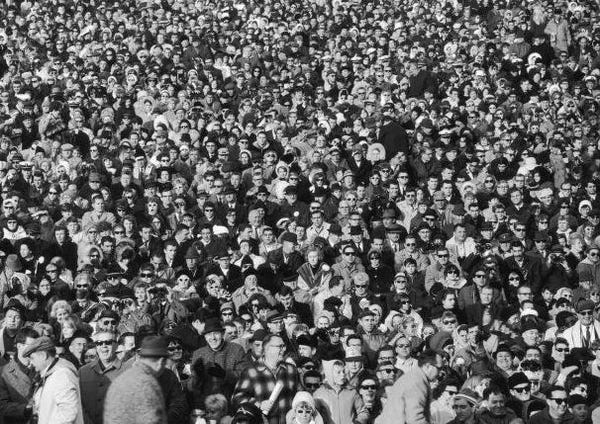
When you are old, your personal discount of the future is big and pervasive. That’s because you haven’t got a whole lot of future to worry about. It’s today, tomorrow, and maybe the day after tomorrow, that matter. “Had we but world enough and time,/ This coyness, lady, were no crime.” (Andrew Marvell, “To His Coy Mistress”) How important is it to you if non-aligned AI rearranges or obliterates humanity a decade from now, if it destroys humankind because people stand in the way of paperclip production? It’s hard to get worked up about a future which doesn’t include you.
Many criticize this attitude. They speak of “the tragedy of the horizon.” In 2015, when he was a little-known central banker, Mark Carney said, “We don’t need an army of actuaries to tell us that the catastrophic impacts of climate change will be felt beyond the traditional horizons of most actors—imposing a cost on future generations that the current generation has no direct incentive to fix.” Has Carney, perhaps, changed his approach since then? In an Endgame essay last year, I mentioned a book called The Good Ancestor which advocates long-term thinking. Says this book: “[H]umankind has always had the innate ability to plan for posterity and take action that will resonate for decades, centuries, even millennia to come. If we want to be good ancestors and be remembered well by the generations who follow us, now is the time to recover and enrich this imaginative skill.” My comment? “Too many adjectives and hortatory verbs. Another vapid big idea.” This cynicism was not well-received by some virtuous readers.
What is justice between generations? What do we owe people who will live a century from now, who don’t exist at the moment and cannot reciprocate whatever we give them? The philosopher John Rawls argues that decisions about justice should be taken behind “a veil of ignorance” (this is his famous notion of an “original position”). We should decide things as if we don’t know which generation we belong to. This implies we should not discount the future, certainly when it comes to social policy.
The problem of intergenerational justice is dramatically drawn in Liu Cixin’s novel The Three-Body Problem. (Barack Obama said of this novel when he was president, “The scope of it was immense. So that was fun to read, partly because my day-to-day problems with Congress seem fairly petty...”) Aliens from a distant doomed planet set out to colonize Earth, on a journey through space that will take 450 years. Their expected arrival in the distant future becomes known on Earth. There are many reactions. Some propose that immense resources be committed to defensive projects whose benefits will be enjoyed only by their distant descendants. Others are not interested in an invasion that is centuries away.
Tell me, what is the virtuous position?
*****
Some comments from readers on Endgame Essay #139 (“Almost a doctor”)
From the distinguished medic, David Goldbloom: “As someone who stopped being a doctor at age 69 after a long career in medicine that I loved, it is jarring to read of people entering the profession at an older age than when I left. It’s not just that medical education is demanding but also that it is a huge investment by society that pays returns over three to four decades for clinical care, research, and teaching the next generations. That’s time these septuagenarians don’t have... Stick to watching ER and The Pitt. They may have technical advisors who ensure the accuracy of the terminology and the procedures, but the pace and intensity of the drama are about as accurate as police or law procedurals. The former chair of CAMH, a retired OPP Superintendant, told me that in the cop shows I liked, what happened in a single episode would, spread over a lifetime, make for an exciting career... All that said, I get the allure of a life in medicine; it was wonderful.”
David Wolinsky, still irrepressible, writes from British Columbia: “I believe you may have inadvertently discovered Herodotus’s fountain of youth, the second go around. The vast majority of people choose a profession or other occupation at the age of 18 to 22 before they’re even intelligent or sophisticated enough to choose their own clothes, and then suffer with that choice for 40 plus years until hopefully they can retire, leave that dreaded choice behind and wait for the grim reaper. Now upon retirement, with the knowledge and sophistication gained from four decades plus of drudgery, they can choose some endeavour they wished they had chosen the first time and pursue another four decades of work staying alive only for that blessed day when they can retire once again. They say nobody dies before Christmas or some other significant life event because they will themselves to live until after, so we will all somehow will ourselves to live until the next blessed retirement. Your friend Bill copped out because of his fear of the heat on St. Vincent so he’ll never know the blessed relief of retiring at the age of 130 after standing on his feet all day listening to and treating old codgers like ourselves complaining about what hurts. But not me. After a brief career as an army officer and then five decades of law neither of which I particularly cared for, you have motivated me to leave retirement behind, and going forward for the next five decades I shall pursue my second go around as an architect, something for which I believe I’m ideally suited since I recently put together my IKEA bookcase all by myself. I’m already looking forward to my second retirement at age 140 so thank you.”
From Martin Levin (a literary gent): “I would go to medical school in some exotic locale, save for my dread at having to treat preeclampsia and people with objects lodged in their rectum.”
Peter Mushkat in Nova Scotia comments: “Back in the day one did one’s basic medicine with Dr. Kildare and further training with Ben Casey.”
And the last word goes to Julian Porter, still my severest critic: “What horse shit! You pose as an erudite philosopher, only to be revealed as a devotee of ER. I suppose it is better than The Young and the Restless...”
*****
And a few recommendations to help while away the hours...
Terry Eagleton, A Death of One’s Own: Reflections on Mortality (2026). Eagleton is a former professor of English literature at Oxford. In his preface, he writes; “I originally intended to publish this book posthumously, with a preface denying that my recent death was a publicity stunt to promote its sales.” A Death of One’s Own ranges widely in time and subject. It is often profound and challenging. For example, Eagleton discusses those who jumped from the World Trade Center in 2001. He describes that act as “a spontaneous gesture of freedom... They made their deaths their own, converting the objective into the subjective, victimhood into agency... [D]eath was not the aim of their actions... it was purely incidental.” Much of Eagleton’s discussion of mortality is gentle and humorous: Some of it is not.
Emma Cline, Switzy: A Novel (2026). This is the story of an older wealthy man with dementia travelling from America to Switzerland for assistance in dying. I suspect it captures well the experience of advanced cognitive impairment. “The shock when he had gone to tie his shoelaces. Tried and failed. Tears, then, like a child. He sat, bent over, with the laces in each hand. He held tight to the laces. Then tighter. Whatever he was supposed to do next was lost in the tundra of his brain.” Switzy is a hard read, but worth it. Or you could wait for the Broadway musical.
Past, Present, Future: The History of Ideas. This brilliant and elegant podcast presented by the polymath David Runciman has begun a new series about what it means to live in a world of ageing populations. In the first episode, called “Lifespan vs Healthspan,” Runciman chats with the geneticist Adam Rutherford. At one point, Runciman mentions a tech bro claim that “AI will solve disease.” Comments Rutherford: “To solve disease, I mean, what the fuck is he talking about when saying things like that?”
“All new people” - This should be applied to some corporate entities (I shall happily select which).
Intergenerational justice is fascinating and I cannot but help observe that it’s practised more in the form than in the observance.
I did enjoy Cixin Liu’s novels and commend your referencing them in this context. The virtuous position is the obvious one, but I doubt most are inclined towards personal sacrifice for future lives as yet unlived. Adam Smith may have agreed with me here. Lots to ponder as I consider my next career.
I enjoy your writing it really make me consider my own opinion.
My wife uses no biological washing powder , free from this and that, organic food, reusable bags and paper packaging.
All for the next generation, but what about me, I want my clothing to smell nice , I like the convenience of mass produced food!!.
But you get older and think, what has my generation left for our children and grandchildren.
What did our grandparents and parents leave for me.
Parents and grandparents,1940’s Nuclear Weapons, the ability to destroy the world at a push of a button.
2000’s our generation developing AI, who thinks the worst thing that has happened to the planet is human kind. It pushes the button for us.
We do not create or produce anything for the future.
As a detectorist I found a coin from 30BC in almost mint condition as they took pride in its production. I have found a modern coin from the 1980’s which had almost completely decomposed because we have become a throw away civilization.
So as I do my bit to reduce plastic and green house gases I fight a loosing battle.
What can I leave my children and grandchildren, hope or hopelessness, I make no difference.