
The Endgame
Newsletter #122 - Even Homer nods

Toronto, November 30, 2025
Even Homer nods
Most people want to get things right. That applies to things big and small, including friendship, parenthood, work, interior decorating, vacation planning, gardening, cooking, playing the piano, playing tennis, fitness training, personal grooming.
But some people won’t settle for getting it right: It must be perfect. For example, if you’re a writer who cares about his craft, you insist your manuscript be flawless. You are distraught when you spot a typo in the final printed version, one that unaccountably you missed in multiple earlier readings of the draft. Perfection, or something close to it, is what E. B. White, an editor at The New Yorker magazine and co-author of The Elements of Style, had in mind when he said, “The best writing is rewriting.” But the drive to be perfect produces anxiety in spades: Perfection is elusive, perhaps unachievable. Consumed by worry, the writer sits in the basement gnawing on his knuckles.
The writer is not alone in the basement. There are lot of non-writer people in there with him. Many of them are aged, anxiety being a particular curse for old people. There is a basketful of things to be anxious about—physical and cognitive decline, loss of independence, loss of purpose, mortality, shrinking social networks, gaining weight, falling down the stairs.
One response is to accept defeat and joylessly embrace the inevitable. What’s the point of striving? We all know how things are going to end. “...[R]ealisation of it rages out/ In furnace-fear when we are caught without/ People or drink.” (Philip Larkin, Aubade)
Or you could fight back by seeking perfection. “An aged man is but a paltry thing,/A tattered coat upon a stick, unless/ Soul clap its hands and sing, and louder sing/ For every tatter in its mortal dress...” (W.B. Yeats, Sailing to Byzantium) Strive to be perfect in what you can control. Have high expectations. Work harder. Organize better. Pay attention to detail. Make lists. Follow strict routines. Check everything twice. Go on a diet. “Good enough” is not good enough. Soul clap its hands and sing, and louder sing...
The hell of it is that perfectionism itself only increases anxiety. Constant self-criticism is a side-effect of the drive to be perfect. Perfectionism is cruel. It defeats its own purpose. Why have high expectations that you can never meet? Disappointment is everywhere.
What to do? Voltaire in Dictionnaire philosophique: “Le mieux est l’ennemi du bien.” There must be a middle way, between defeat and perfection, that allows for self-kindness and understanding. Perhaps we should reject perfection and settle on excellence, something short of perfection, as the goal to pursue. Excellence is no mean goal. Its pursuit requires strength and fortitude.
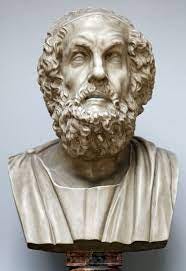
In Ars Poetica, the great Roman poet Horace said of Homer, author of The Iliad and The Odyssey, “et idem indignor quandoque bonus dormitat Homerus” which roughly translates, so I am told, as “and yet I too am annoyed whenever good Homer dozes off.” This has turned into the colloquial comment, “Even Homer nods.” A modern equivalent might be, “Even Alcaraz double faults.” In the 2025 French Tennis Open men’s final, Carlos Alcaraz, considered today the best male tennis player in the world, committed seven double faults (he still won the match, beating Jannik Sinner).

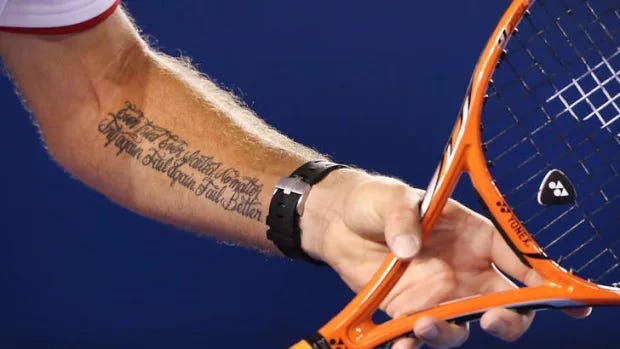
Even Homer wrote the occasional clumsy phrase or sentence. Maybe he was also lousy at decorating his mudbrick Aegean Iron Age house. Even Alcaraz occasionally serves into the net. Another tennis player, Stan Wawrinka, has a famous line from Samuel Beckett’s Worstwood Ho tattooed on his arm: “Ever tried. Ever failed. No matter. Try again. Fail again. Fail better.”
P.S. By coincidence, yesterday The New York Times published a guest essay by Jonathan Biss entitled “I’m a Concert Pianist. This Is Why I Seek Imperfection.” Biss writes: “[F]etishization of perfection might not be surprising, but that doesn’t make it any less damaging. You cannot learn or grow while trying to appear as if you have everything figured out. You cannot talk to God by trying to avoid doing something wrong.” (Biss begins his essay by quoting Patti Smith: “As a performer, one has a mission, like Coltrane, to take your solo out to talk to God.”) I discussed this essay with my piano teacher, and he said, “It’s true, perfection can become the enemy of creativity, the enemy of art,” which I found reassuring.
*****
Some reader comments on Endgame #121 (“A visit to the doctor”)
From the irrepressible David Wolinsky: “As for my monthly doctor visits, I prefer to think of them as collegial consultations. As a committed hypochondriac, I generally attribute any random ache or pain to one of the diseases the subject of every second TV commercial with the usual side effects of their curative products being nausea, massive diarrhea, fainting, constipation, or death, so I require my medical colleague’s input to know which of the products to choose and which of the side effects to expect. I avoid any feelings of guilt over these multiple visits by wearing scrubs or a white coat myself.”
From Brent Willock: “Thank you for sharing your reflections of visiting physicians, particularly in one’s older years. This is an important conversation. There is considerable variation among physicians as to whether they are open to questions and dialogue. The worst ones, by their curt, brushoff responses, communicate they have no interest or willingness to explore one’s concerns.”
John Gregory asks about dentists: “Do dentists count? Mine likes to call me in every four months (the limits of what my insurance will help with, in the absence of urgency), so that’s three on the list already. I’m a little shy of 80, but won’t be far shy of that 15 [visits to the doctor] this year—largely for checkups rather than complaints, so far, fortunately.”
*****

Some people have asked me why they should buy my new book when they’ve already read everything in it on Substack. Bronwyn Drainie has the answer: “At a certain age, you forget what you’ve read as soon as you finish reading it. So even though I’ve been a faithful subscriber to and reader of “The Endgame” since it first appeared in late 2022, I had totally forgotten most of it, and coming across all your wise, clever, sad, droll and brilliant observations between these new covers feels like discovering a fresh green New World!”
All Remaining Passengers is available from Amazon and other online book sellers in most countries, and from some independent bookstores in Canada (coast-to-coast) including Ben McNally Books and Book City (Yonge & St. Clair branch) in Toronto, Munro’s Books in Victoria, B.C. (where, for some reason, it’s selling like warm cakes), Russell Books in Victoria, and Salt-Water Ballad Books in Port Medway, Nova Scotia.
Perfection is a direction, not a state, except in mathematics.
I think we all know perfection is highly overrated.